Application & pipeline snapshot
Figures from the SmartSheet intake (124 submissions) and the DK Request Tracker (74 entries).
Total Applications Received
0
SmartSheet intake
Moved to Request Tracker
0
Advanced to detailed review
Declined (Pre-Tracker)
0
Screened out before tracker
Under verification
0
Awaiting initial screening
Tracker Pipeline Status (74 Requests)
Approved
0
Approved by Amazon
Rejected (In Tracker)
0
Rejected during review
On-Hold
0
KYC & Project DD
Approved Grants Status
| Project Completed (FUC Received) | 19 |
| Payment Pending | 3 |
| Partial Grant Disbursed | 2 |
| Paid from Other Partner Org | 2 |
| Project In-Progress (FUC Pending) | 1 |
| Project Yet to Start | 1 |
| Total approved grants | 28 |
Implementation of the 28 approved requests
Executed through Donatekart Foundation14
- 3 executed directly
- 11 via NGO partners
Executed directly by NPOs14
- Across 13 unique NPOs
Overall implementation network25
Unique NPOs spanning DKF, vetted NGO partners and independent NPOs.
Observations: Approval rate is 22% of total requests (124 - smart sheet entries)
Recommendation: Streamline the review through Lean DD and other process optimizations (covered below)
Why Applications Were Declined
Smart sheet
Tracker
Observation: CPV > $50 is the biggest rejection driver, accounting for 40% of pre-tracker declines/no response.
Recommendation: Introduce a CPV guardrail with alerts on the smart form.
Funds Overview and Active Proposals
Funds Overview
Active Proposals
Cost Per Volunteer
Observation: Cost per volunteer remains consistent at ₹12K–26K across different calculation methods.
Recommendation: Increase volunteer participation & track sign-ups from the Givehub link to reduce the cost per volunteer.
What volunteers applied for?
Grant type Break-up of 74 Requests on Request Tracker
28 approved grants funds disbursed
Who the programme reached
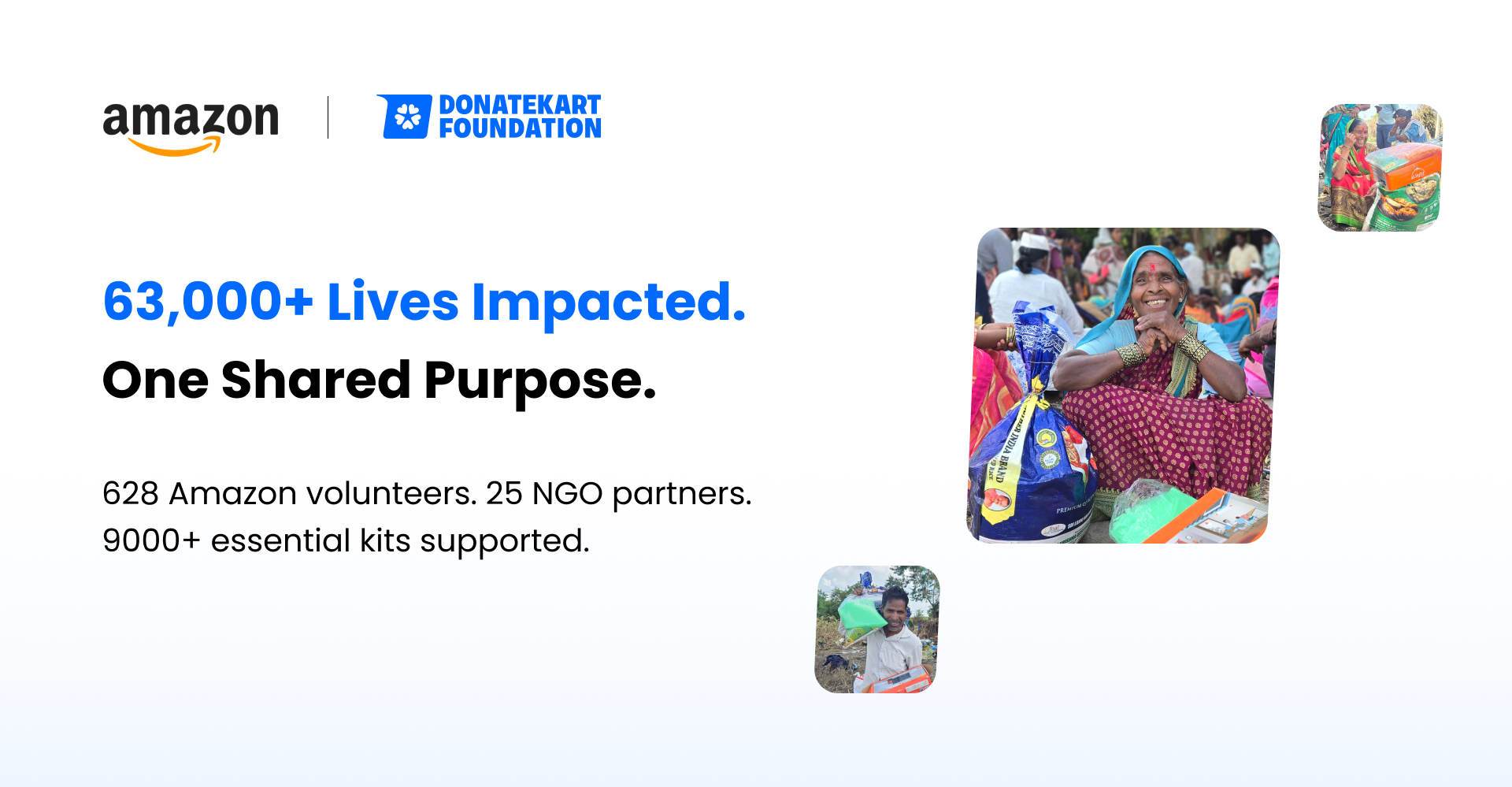
Distributions reached 21 districts across 10 states, engaging 25 unique NGO partners.
0
Direct beneficiaries
Individuals directly receiving assets or services
0+
Indirect beneficiaries
Household members and wider community reach
0
Children reached
Largest single direct beneficiary group
0
Women impacted
Via sewing kits, MHM kits and blanket distributions
0
Persons with Disabilities
Primarily through relief kit distributions
0
Amazon volunteers
Across 25 NGO partnerships
0
Unique NGOs
Partner organisations engaged
0
Assets created
Across 13 asset types
Assets created & distributed
Observation: The programme achieved broad beneficiary reach across geographies and communities.
Recommendation: Create standard impact measurement framework for all asset types to quantify outcomes and build NGO capacity to improve impact reporting.
States & districts covered
States & districts covered
Reach by state
10 states · 21 districtsObservation: The programme reached 10 states and 21 districts covering 35% of India.
Recommendation: Need to implement promotional strategies to reach rural part of India.
Where time went
DD Approval → Payment is the largest bottleneck at 38.3 days average, with only 20% completing within 14 days.
DD Request → Form submission
Avg
13.9d
Max
123d
Form submission → DD Approval
Avg
15.9d
Max
34d
DD Approval → Payment
Avg
38.3d
Max
90d
Observation: Most delays occur in KYC & Proposal DD stage : to & fro submission.
Recommendation: Initiate project DD before KYC to reduce the SLA time and revamp the process.
Submissions & approvals by month
What employees experience today
Our primary customers are employees and for them NGO experience is important
“I only found out my CPV was too high after my grant was rejected”
40% of all rejections are from a cost-per-volunteer rule never shown during submission. Employees apply for ineligible grants.
CPV check before employee submits the form.
1. Employee enters volunteer count + budget, tool flags if they're not within limit before submitting
2. Quick 3-rule NGO eligibility check - Pan Card, Trust Deed, ITR auto-flags before form is submitted
“I want to know, what is the status of my grant ?”
Employees and their partner NGO followup multiple times over mail to check the status of their grant. Better NGO experience will enhance employee vol experience.
Dedicated Volunteering Grants page for employees.
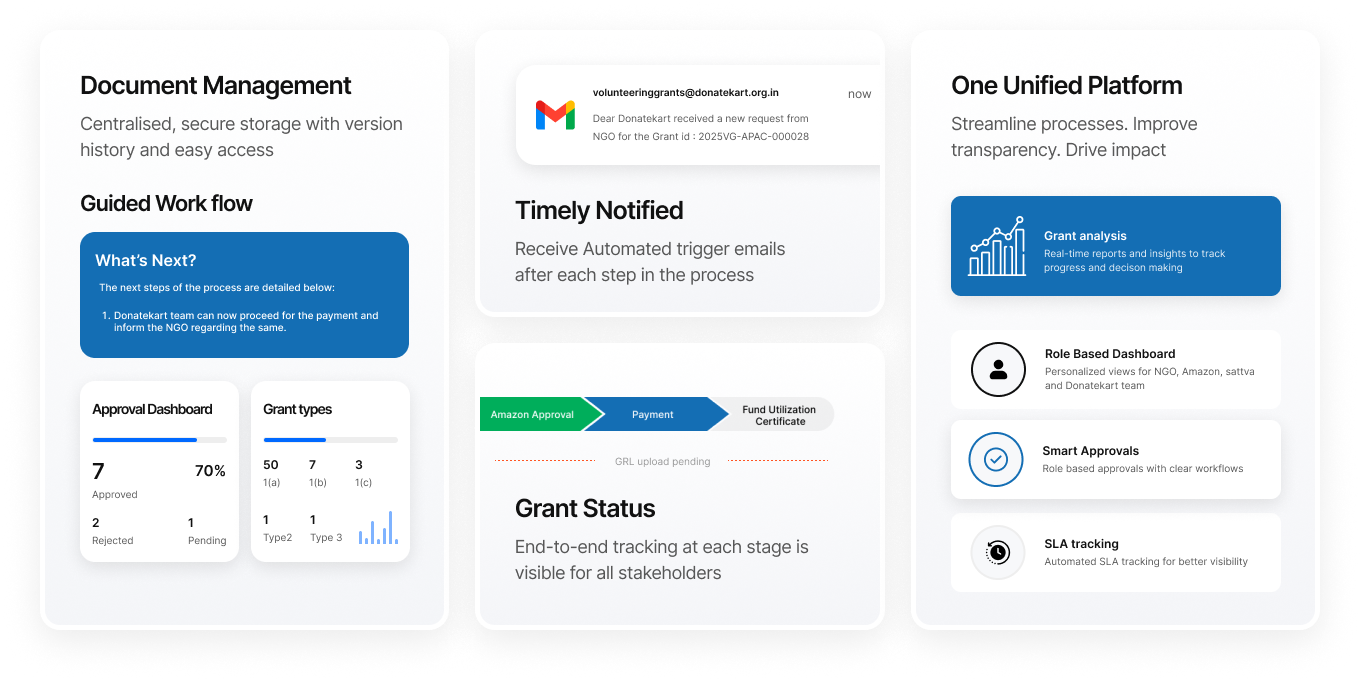
1. Grant status tracker - employee enters their Grant ID and sees exactly which stage it's at in real time
2. Simple consolidated page with everything systematically - Employee / NGO needs before and during the application. Covering - Success story, Live Impact etc.
“My NGO had to resubmit documents min 3 times for DD”
75 document failures across 29 NGOs - mostly format misunderstandings: wrong ITR, self-signed letters, no budget breakdown. Each round takes days
Streamlined DD for grants under ₹10L.
1. 50% lean DD for grants < 10L
2. One unified platform for KYC, proposal & impact report · Automated stage-wise notifications to all stakeholders.

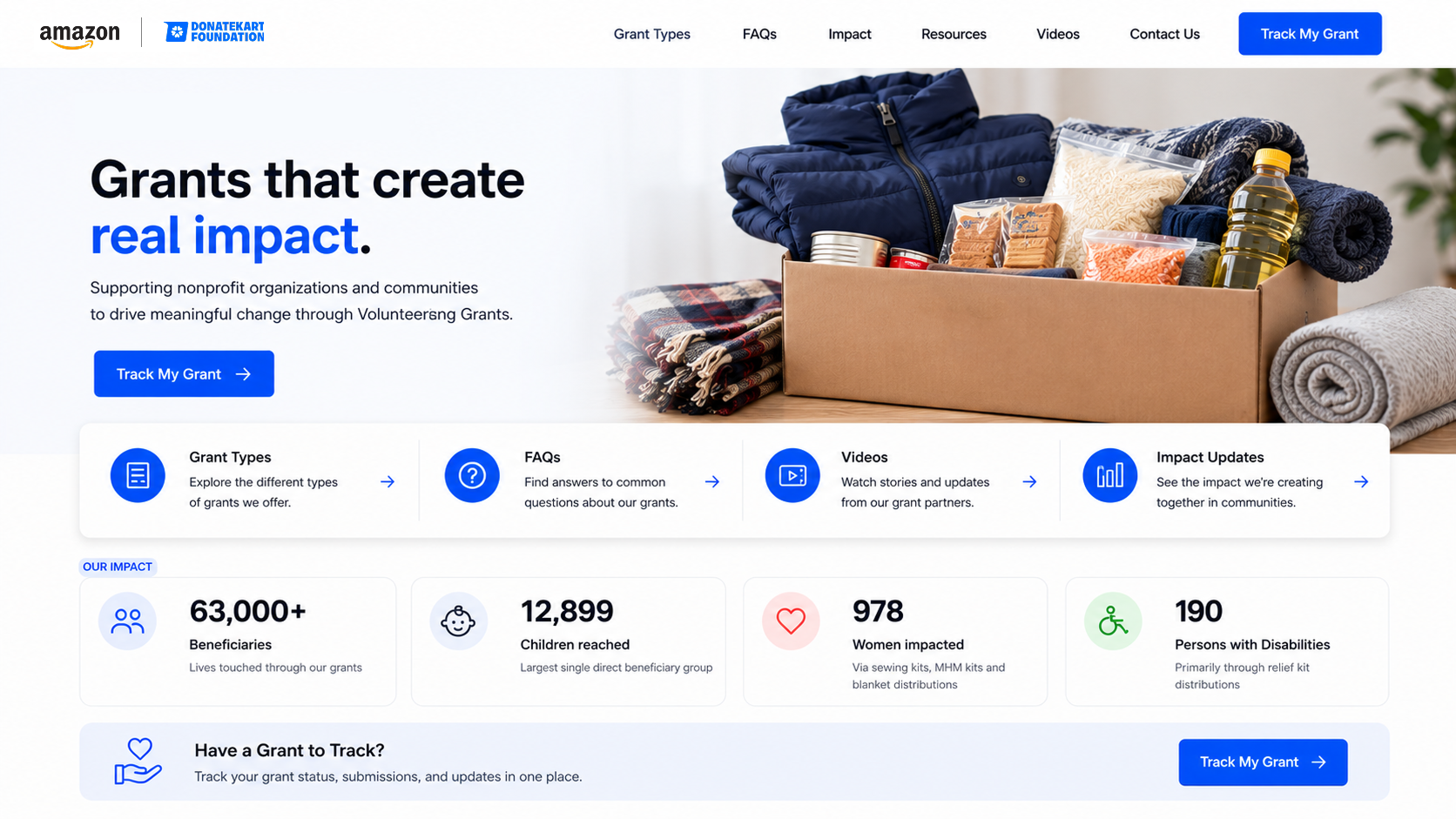
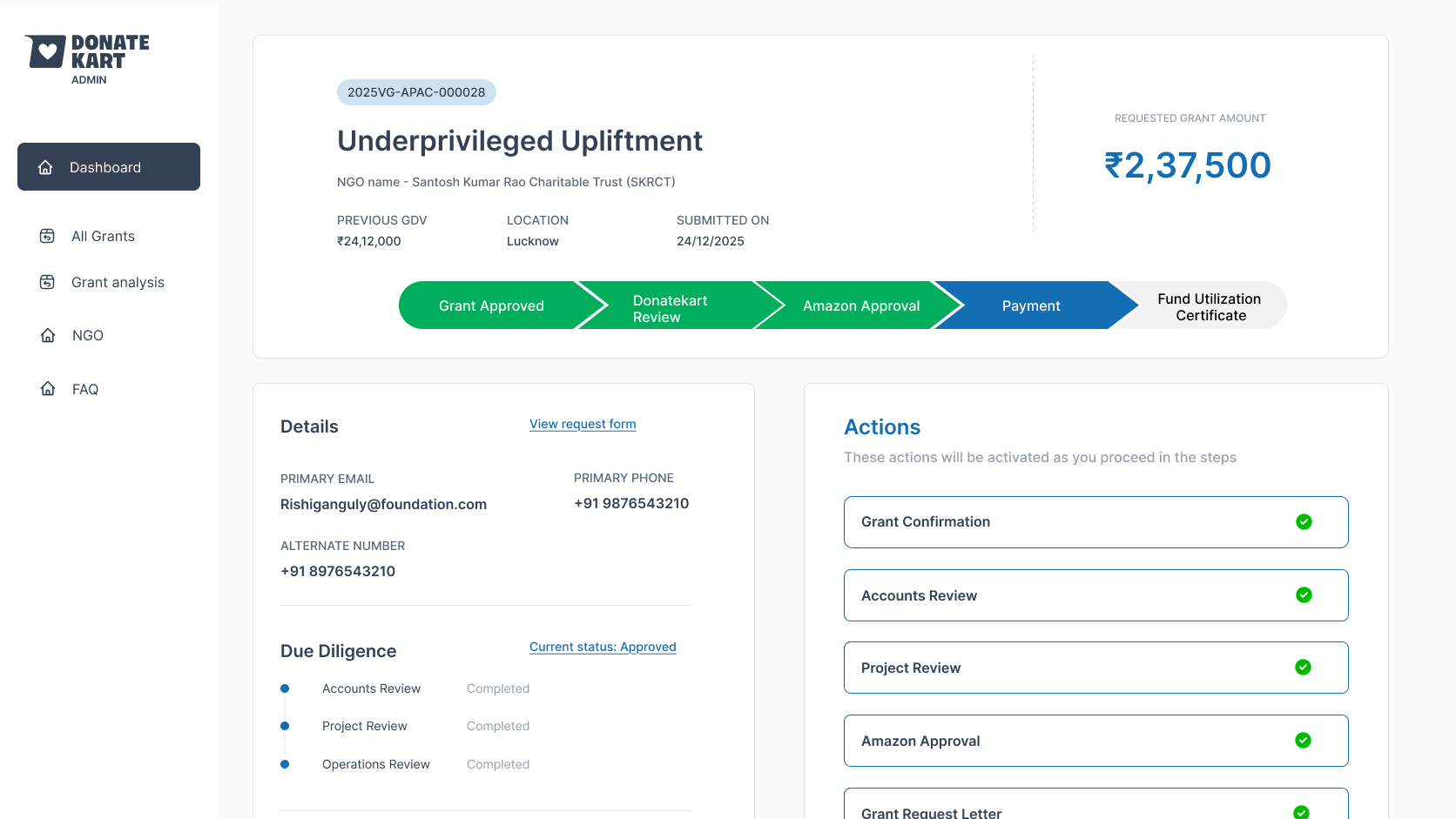
Platform Preview (2 Views)
Screen 1: A consolidated employee portal providing everything required before and during the grant application, including Grant Types, FAQs, Help Videos, Impact Updates, and Track My Grant.
Screen 2: A grant dashboard providing a clear view of the grant status at every stage, along with key details and pending action items.
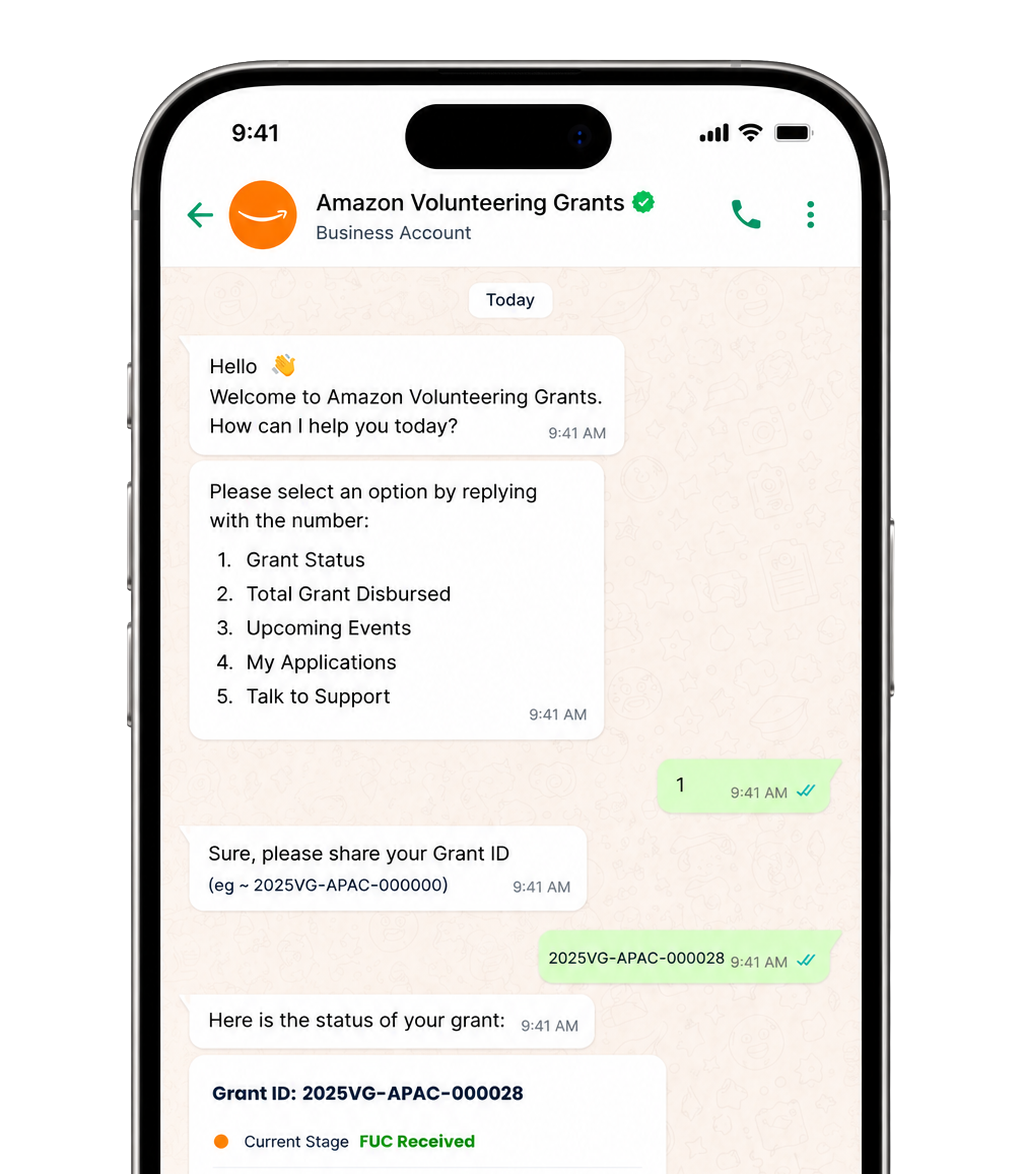
WhatsApp Bot for Grant Status
Volunteers and NGOs check their grant status by sending the Grant ID to a WhatsApp Business number.
What NGOs experience today
NGOs are key partners in delivering impact. Their experience directly shapes the programme's success.
“We get asked to resubmit documents 4–5 times.”
75 document failures across 29 NGOs - mostly format issues: wrong ITR, self-signed letters, no budget breakdown. No resubmission path in Zoho.
Structured resubmission path on the platform.
1. Document-specific rejection reason, NGO sees what failed and why
2. In-form resubmission re-upload only the failed docs, not the full form · Pre-loaded ITR sample, budget template, auth letter template
“We have no idea where our grant stands.”
NGOs chase status over email and WhatsApp after every submission. 39-day avg review time with no acknowledgement or stage updates.
Automated stage-wise notifications.
1. Auto-acknowledgement on KYC submission with expected timeline
2. Stage-change alerts: KYC received → DD Approved → Payment initiated · Grant ID tracker, NGO checks live status without chasing anyone
“Meeting the criteria for a ₹10L grant feels like a lot.”
13 documents, full financial scrutiny, 12-step DD, same process for a ₹5L grant as a ₹25L grant. Effort outweighs the benefit for small NGOs.
Lean DD for grants under ₹10L.
1. 50% lean DD for grants < ₹10L - 6 core docs instead of 13
2. Fast-track for verified repeat NGOs · Pre-screening in 3 questions before full form · One unified platform for KYC, proposal & impact report
The KYC bottleneck
Document failure rate (29 NGO submissions)
Proposed Lean DD Solution
| Document | Full DD (Above ₹10 Lakhs) | Lean DD (Below ₹10 Lakhs) |
|---|---|---|
| PAN Card + Cancelled Cheque (current account) | Mandatory | Mandatory |
| Registration Certificate / Certificate of Incorporation | Mandatory | Mandatory |
| Trust Deed / MoA / Bylaws (containing Objects and Names of Members) | Mandatory | Mandatory |
| GRL Grant Requisition Letter | Mandatory | Mandatory |
| NGO Darpan Certificate | Mandatory | Mandatory |
| Latest FY ITR / Audit Report / Financial Statements | Mandatory (latest ITR) | (one year only) |
| FUC Utilisation Certificate (Post-event) | Mandatory (formal utilisation certificate) | (self-declared on NGO letterhead) |
| Aadhaar Card of NGO Office Bearer | Mandatory | - |
| Aadhaar Card of NGO SPOC | Mandatory | - |
| Authorization Letter by Office Bearer to SPOC | Mandatory | - |
| 12A Registration Certificate | Optional | Optional |
| 80G Registration Certificate | Optional | Optional |
Lean DD reduces mandatory documents by 40% (10 → 6), with 2 documents moved to reduced verification.
Current grant process at a glance
An end-to-end view of how grants move today a fragmented, manual workflow spanning multiple platforms and stakeholders with no automation.
17
Process Steps
End-to-end grant lifecycle managed through 17 manual steps.
7
Platforms Used
Work happens across 7 disconnected platforms with no integration.
Fully Manual
No Automation
No automated triggers, routing, reminders or status tracking.
What This Means
High Operational Overhead40+
Emails / Grant
Average email exchanges per grant with no query tracker in place.
4–5
KYC Revision Cycles
No resubmission path in Zoho Forms; NGOs re-email corrections each round.
~30
Follow-ups / Grant
Manual chasing at every stage; no automated task assignment or alerts.
6–8 hrs
Coordination / Grant
Sattva effort per grant cycle spent on coordination across systems.
16 / 74
Entries Missing Status
Data quality gap in the tracker; risk of duplicates, typos and missed rows.
1–7 Days
Lost on GRL
Print → sign → scan → email adds 1–7 days to the approval-to-payment flow.
Process Inefficiency Overview · all 17 steps
| # | Step | Tool | Inefficiency Type | What Goes Wrong | Follow-ups | GMS Solution |
|---|---|---|---|---|---|---|
| 01 | Volunteer submits grant application | Smartsheet | None | — | 1 (20 min) | _ |
| 02 | Sattva reviews and resolves queries with volunteer | Communication / Task management | 40+ email exchanges per grant. No query tracker. Difficult to see what is open vs resolved across 74 active grants. | 2 (1 to 2 days) | _ | |
| 03 | Amazon Grant ID manually added to DK tracker | Sheets and Tracker | Manual effort / Data management | Risk of incorrect, duplicate or missed entries. 16 of 74 tracker entries currently have no status. | 1 (15 min) | _ |
| 04 | Sattva shares DD form | volunteer adds NGO POC to thread | Email and Sheets | Communication / Task management | Entirely dependent on manual emails and volunteer responsiveness. No automated trigger. | 1 (2 to 4 hrs) | Automated NGO Onboarding |
| 05 | NGO fills and submits DD form with documents | Zoho Forms | Manual effort / Document management | 4 to 5 revision cycles on average. No resubmission option. NGO must re-email corrections each time. | 2 (2 to 3 days) | Unified DD Submission |
| 06 | DD email manually routed to compliance and project owners | Communication / Task management | No automated task assignment or notification. Assignment depends on who reads the email first. | 2 (4 to 6 hrs) | Automated DD Routing | |
| 07 | Compliance documents downloaded and reviewed manually | Google Drive and Email | Manual effort / Tracking | Multiple back-and-forth cycles. No automated triggers. No follow-up alert if reviewer is idle. | 3 (2 to 3 days) | Structured Compliance Review |
| 08 | Project details validated via Google Sheets | Google Sheets | Manual effort / Tracking | No real-time tracking. Manual submission. Version control issues. | 2 (1 to 2 days) | Guided Project Review |
| 09 | DD completion communicated internally to DK team | Communication / Task management | Manual confirmation and repeated follow-ups before action is taken. | 2 (30 min) | Automated DD Updates | |
| 10 | DK emails DD completion and Drive links to Amazon and Sattva | Email and Drive links | Document management / Communication | Attachment confusion, access errors, and version conflicts. Frequent clarification needed. | 2 (2 to 4 hrs) | Consolidated DD Submission |
| 11 | Amazon verifies DD and gives clearance | Approval tracking | Approval status available only via email. Updates are missed. No shared status view. | 1 (1 to 2 days) | Digital Approval Dashboard | |
| 12 | Sattva communicates approval | initiates Givehub and GRL | Givehub and Email | Communication / Task management | Multiple stakeholder actions all manually triggered from one email. | 2 (30 min) | - |
| 13 | GRL emailed | NGO prints, signs, scans and submits | PDF and Email | Manual effort / Document management | Print to sign to scan to email process adds 1 to 7 days depending on signatory availability. | 2 (1 to 2 days) | Digital GRL Workflow |
| 14 | Sattva manually checks whether minimum Givehub signups are reached | Manual validation / Tracking | Signup count checked by opening event page manually. No threshold alert. | 1 (2 to 4 hrs) | - | |
| 15 | DK proceeds with payment | Email and Trello | Communication / Task management / SLA tracking | Coordination across 3 separate systems: email, Trello, banking. | 2 (4 to 6 hrs) | Integrated Payment Workflow |
| 16 | Payment completion communicated to all stakeholders | Banking and Email | Communication | Status shared across email, Trello, tracker and phone. No single channel. | 2 (30 min) | Automated Payment Update |
| 17 | NGO submits FUC | DK manually verifies documents | Email and Drive | Manual effort / Reporting / Audit tracking | Manual follow-ups. Late submissions delay programme closure and reporting. | 2 (7 to 9 days) | Structured FUC Workflow |
Volunteer submits grant application
- Tool
- Smartsheet
- Inefficiency Type
- None
- What Goes Wrong
- —
- Follow-ups
- 1 (20 min)
- GMS Solution
- _
Sattva reviews and resolves queries with volunteer
- Tool
- Inefficiency Type
- Communication / Task management
- What Goes Wrong
- 40+ email exchanges per grant. No query tracker. Difficult to see what is open vs resolved across 74 active grants.
- Follow-ups
- 2 (1 to 2 days)
- GMS Solution
- _
Amazon Grant ID manually added to DK tracker
- Tool
- Sheets and Tracker
- Inefficiency Type
- Manual effort / Data management
- What Goes Wrong
- Risk of incorrect, duplicate or missed entries. 16 of 74 tracker entries currently have no status.
- Follow-ups
- 1 (15 min)
- GMS Solution
- _
Sattva shares DD form | volunteer adds NGO POC to thread
- Tool
- Email and Sheets
- Inefficiency Type
- Communication / Task management
- What Goes Wrong
- Entirely dependent on manual emails and volunteer responsiveness. No automated trigger.
- Follow-ups
- 1 (2 to 4 hrs)
- GMS Solution
- Automated NGO Onboarding
NGO fills and submits DD form with documents
- Tool
- Zoho Forms
- Inefficiency Type
- Manual effort / Document management
- What Goes Wrong
- 4 to 5 revision cycles on average. No resubmission option. NGO must re-email corrections each time.
- Follow-ups
- 2 (2 to 3 days)
- GMS Solution
- Unified DD Submission
DD email manually routed to compliance and project owners
- Tool
- Inefficiency Type
- Communication / Task management
- What Goes Wrong
- No automated task assignment or notification. Assignment depends on who reads the email first.
- Follow-ups
- 2 (4 to 6 hrs)
- GMS Solution
- Automated DD Routing
Compliance documents downloaded and reviewed manually
- Tool
- Google Drive and Email
- Inefficiency Type
- Manual effort / Tracking
- What Goes Wrong
- Multiple back-and-forth cycles. No automated triggers. No follow-up alert if reviewer is idle.
- Follow-ups
- 3 (2 to 3 days)
- GMS Solution
- Structured Compliance Review
Project details validated via Google Sheets
- Tool
- Google Sheets
- Inefficiency Type
- Manual effort / Tracking
- What Goes Wrong
- No real-time tracking. Manual submission. Version control issues.
- Follow-ups
- 2 (1 to 2 days)
- GMS Solution
- Guided Project Review
DD completion communicated internally to DK team
- Tool
- Inefficiency Type
- Communication / Task management
- What Goes Wrong
- Manual confirmation and repeated follow-ups before action is taken.
- Follow-ups
- 2 (30 min)
- GMS Solution
- Automated DD Updates
DK emails DD completion and Drive links to Amazon and Sattva
- Tool
- Email and Drive links
- Inefficiency Type
- Document management / Communication
- What Goes Wrong
- Attachment confusion, access errors, and version conflicts. Frequent clarification needed.
- Follow-ups
- 2 (2 to 4 hrs)
- GMS Solution
- Consolidated DD Submission
Amazon verifies DD and gives clearance
- Tool
- Inefficiency Type
- Approval tracking
- What Goes Wrong
- Approval status available only via email. Updates are missed. No shared status view.
- Follow-ups
- 1 (1 to 2 days)
- GMS Solution
- Digital Approval Dashboard
Sattva communicates approval | initiates Givehub and GRL
- Tool
- Givehub and Email
- Inefficiency Type
- Communication / Task management
- What Goes Wrong
- Multiple stakeholder actions all manually triggered from one email.
- Follow-ups
- 2 (30 min)
- GMS Solution
- -
GRL emailed | NGO prints, signs, scans and submits
- Tool
- PDF and Email
- Inefficiency Type
- Manual effort / Document management
- What Goes Wrong
- Print to sign to scan to email process adds 1 to 7 days depending on signatory availability.
- Follow-ups
- 2 (1 to 2 days)
- GMS Solution
- Digital GRL Workflow
Sattva manually checks whether minimum Givehub signups are reached
- Tool
- Inefficiency Type
- Manual validation / Tracking
- What Goes Wrong
- Signup count checked by opening event page manually. No threshold alert.
- Follow-ups
- 1 (2 to 4 hrs)
- GMS Solution
- -
DK proceeds with payment
- Tool
- Email and Trello
- Inefficiency Type
- Communication / Task management / SLA tracking
- What Goes Wrong
- Coordination across 3 separate systems: email, Trello, banking.
- Follow-ups
- 2 (4 to 6 hrs)
- GMS Solution
- Integrated Payment Workflow
Payment completion communicated to all stakeholders
- Tool
- Banking and Email
- Inefficiency Type
- Communication
- What Goes Wrong
- Status shared across email, Trello, tracker and phone. No single channel.
- Follow-ups
- 2 (30 min)
- GMS Solution
- Automated Payment Update
NGO submits FUC | DK manually verifies documents
- Tool
- Email and Drive
- Inefficiency Type
- Manual effort / Reporting / Audit tracking
- What Goes Wrong
- Manual follow-ups. Late submissions delay programme closure and reporting.
- Follow-ups
- 2 (7 to 9 days)
- GMS Solution
- Structured FUC Workflow
The reimagined grant management system
A single, automated platform that replaces the fragmented, manual workflow and the measurable impact it delivers.
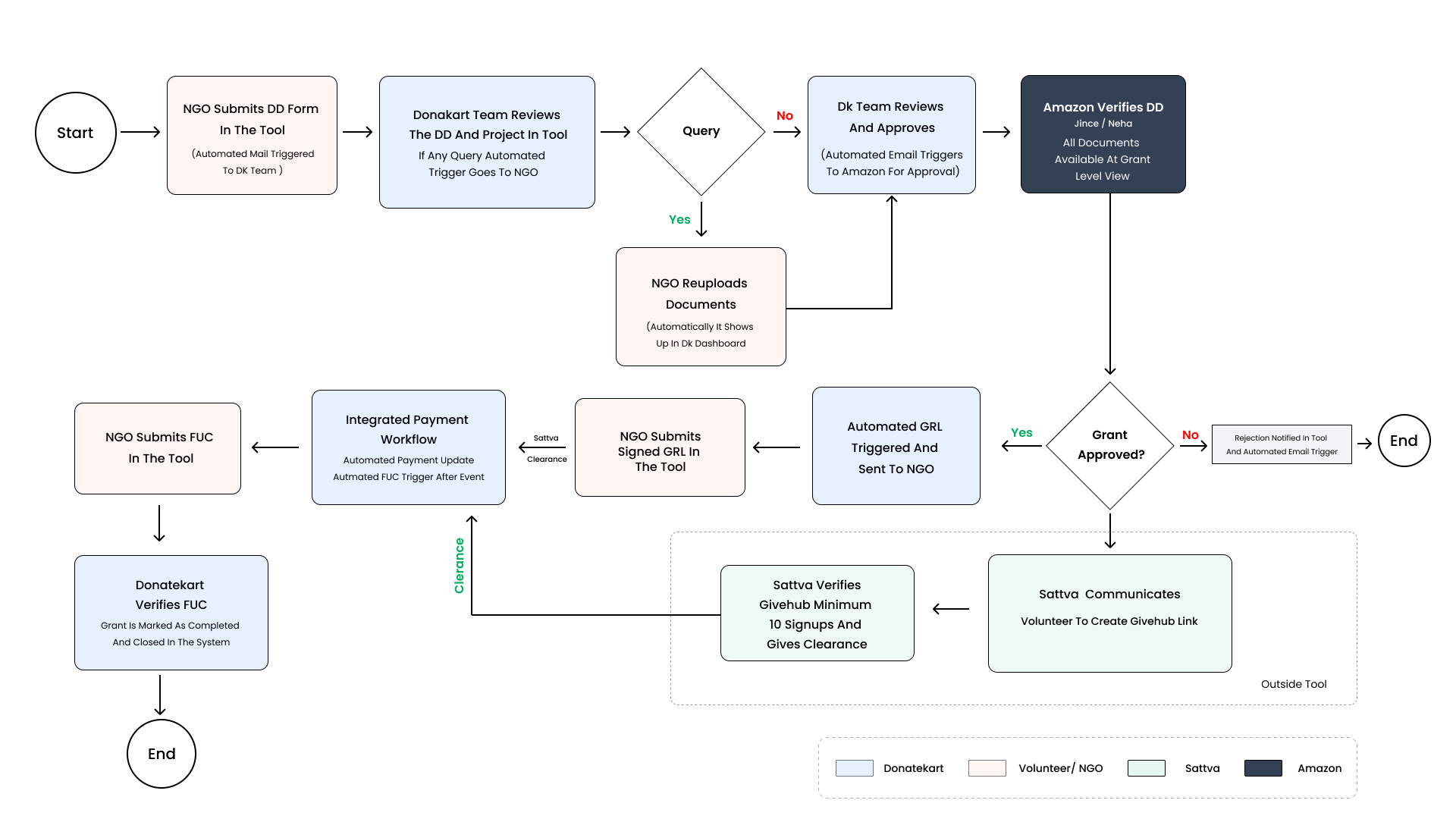
Impact
Grant Processing Time
Excludes external dependencies
Follow-Ups Per Grant
Automated notifications reduce manual coordination
Platforms Used
Single source of truth for all stakeholders
Operational Coordination
Faster stakeholder coordination
Process Visibility
Instant access to grant status and stakeholder actions
SLA Compliance
Timely reminders and accountability
Note: Timelines are indicative estimates for internal processing only and exclude external dependencies such as NGO response time, Givehub signups, event completion and third-party approvals.
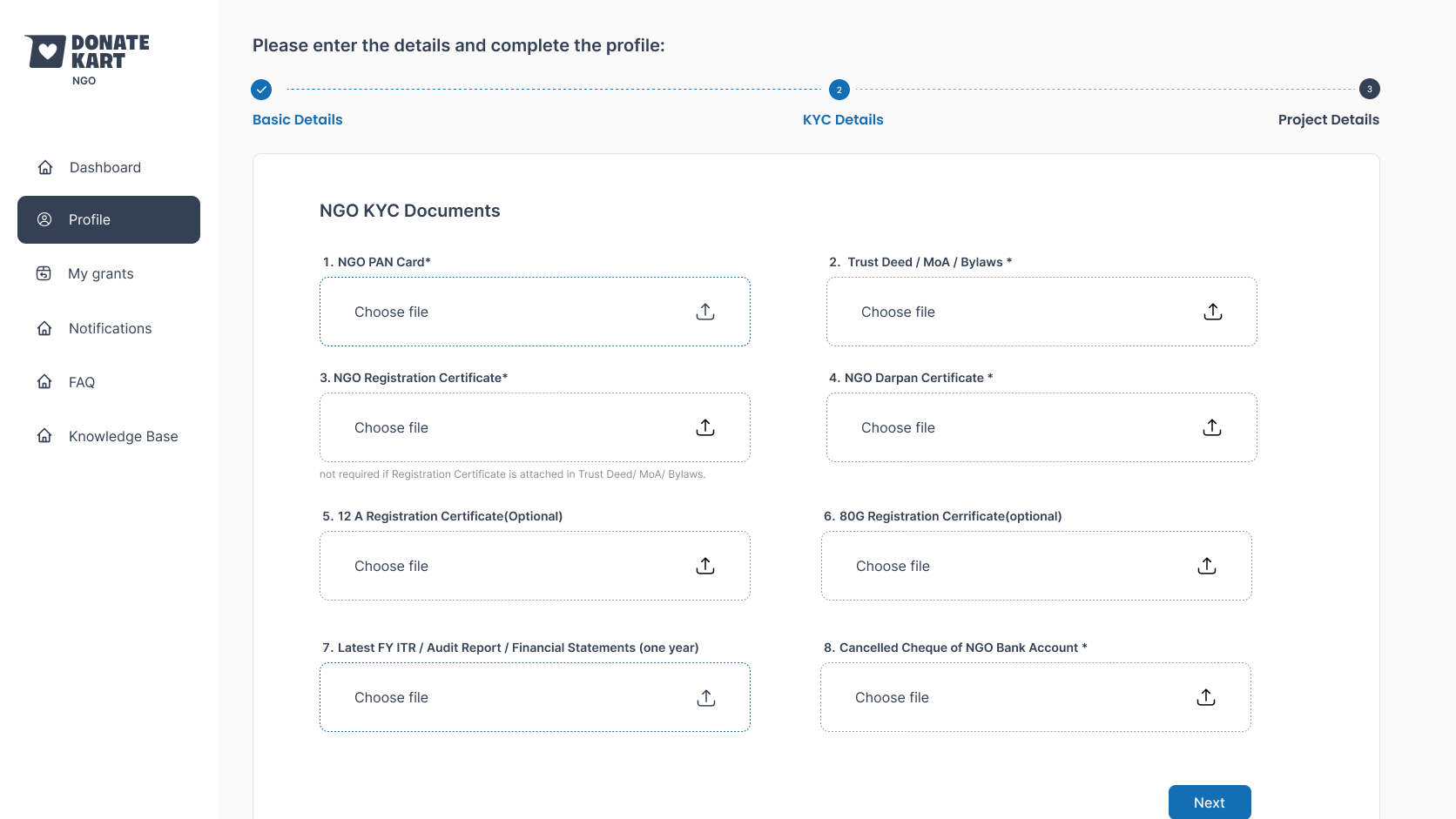
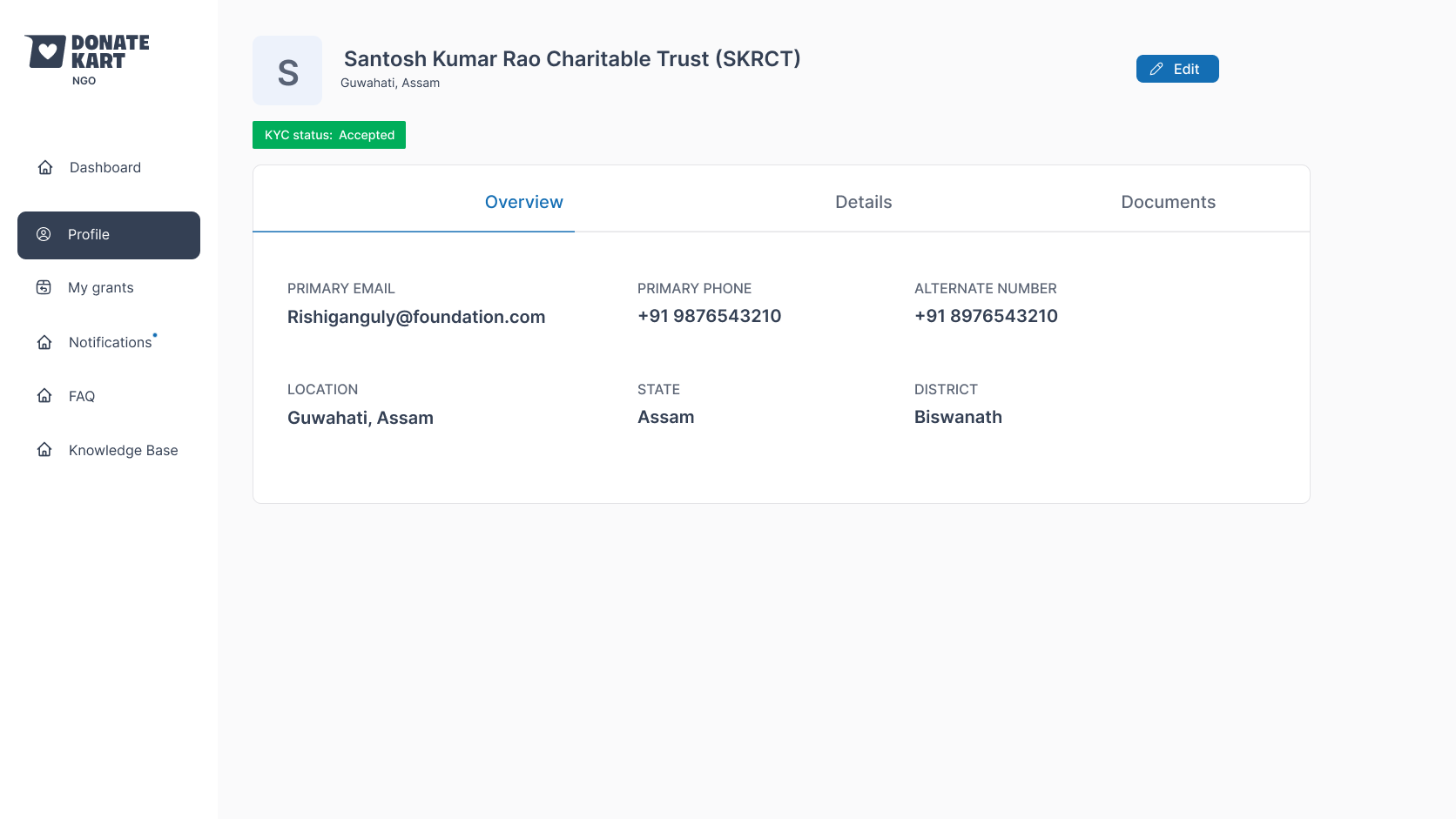
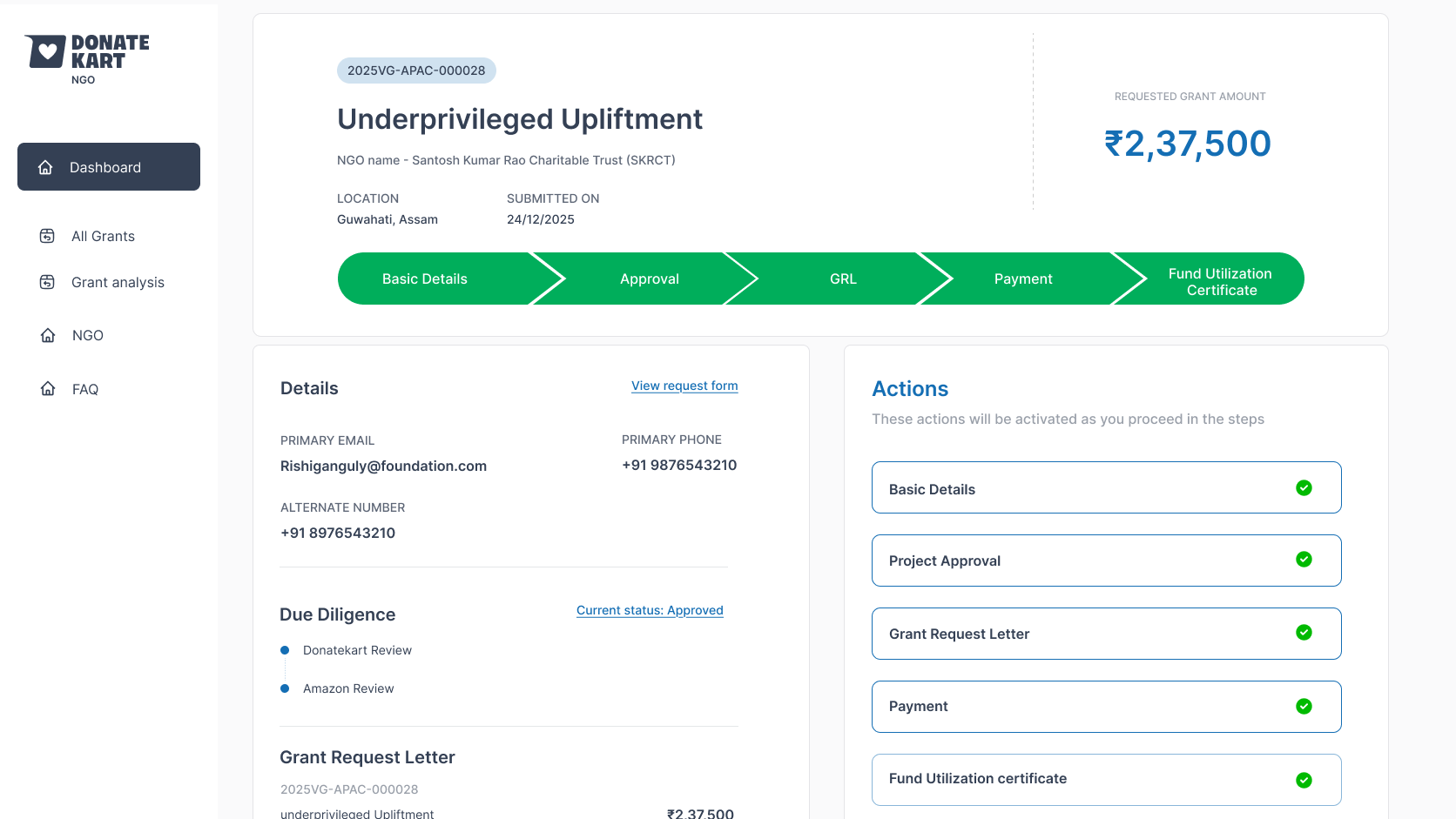
Platform Preview (3 Views)
Screen 1: Lean DD view for NGOs applying for grants below ₹10 lakh.
Screen 2: A dedicated profile page to update documents and organisation details whenever required.
Screen 3: A grant dashboard providing a clear view of the grant status, action items, and key grant details.